Two against Lincoln by William C. Harris
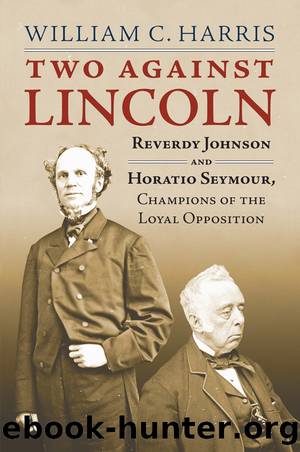
Author:William C. Harris [Harris, William C.]
Language: eng
Format: epub
Tags: History, United States, Civil War Period (1850-1877), Political Science, History & Theory, American Government, National
ISBN: 9780700624126
Google: wzIJMQAACAAJ
Publisher: University Press of Kansas
Published: 2017-01-15T00:27:22+00:00
In Washington and elsewhere during the fall, Lincoln and the Republicans viewed with increasing alarm the Democratic surge in New York and the lower North. In states from New York to Pennsylvania and westward, the Democratic Party, which included a vocal peace or Copperhead wing of the party, threatened to win control of the state legislatures and other offices, imperiling Republican policies and the war effort. Fortunately for the Republicans, no gubernatorial elections were scheduled in 1862 for the border states of Maryland, Kentucky, and Missouri, where opposition to emancipation and concern for civil liberties were strong.
The contest in New York attracted the most attention, and rightly so because of the stateâs political importance in the war. On October 22, William Cullen Bryant, the prominent New York Republican editor and literary icon, excitedly wrote Lincoln and predicted that a Seymour victory âwould be a public calamity,â not only for his state but also the Union. He told the president that New York Republicans desperately needed successes on the battlefield in order to retain control of the state. Without mentioning the presidentâs emancipation and habeas corpus proclamations, which Bryant supported, he informed Lincoln that âthe inactivity of our armies in putting down the rebellion . . . will have a most unhappy effect upon the elections here, as we fear they have had in other statesâ where voting had already occurred. âI have been pained to hear lately from persons zealously loyal,â Bryant reported to Lincoln, âthe expression of a doubt as to whether the administration sincerely desires the speedy annihilation of the rebel forces. . . . This strange sluggishness in military operations seems to us little short of absolute madness.â35
Although he did not mention General McClellan in his letter to Lincoln, Bryant as well as other Republicans, including members of Lincolnâs cabinet, wanted the âYoung Napoleonâ removed immediately from command of the army in Virginia. An observer in Washington wrote a New York friend that the Republican assault upon McClellan threatened a rebellion against the president unless he replaced the general. Finally, on November 5, Lincoln ordered McClellanâs removal from command. However, it proved too late to influence the elections.36
The Republican campaign against Seymour intensified in October as it became clear that the election would be close. Republicans like Bryant feared that not only would the Democrats win the governorship but their candidates, riding on Seymourâs coattails, would gain control of the New York legislature. General Wadsworth, the Republican or Union Party candidate for governor, did not campaign in the state until October 30, when he made a politically ill-advised antislavery speech in New York City. He wrote letters from the field reminding New Yorkers of his military record, which indeed was impressive. Wadsworthâs New York speech damaged the Republicans by reinforcing Seymourâs argument, especially among conservative ex-Whigs, that the state Union Party had become the party of âradical fanatics.â To make matters worse for the Republicans, Horace Greeley in the New York Tribune went overboard and engaged âin an orgy of vilificationâ against Seymour, as one historian has put it.
Download
This site does not store any files on its server. We only index and link to content provided by other sites. Please contact the content providers to delete copyright contents if any and email us, we'll remove relevant links or contents immediately.
The Secret History by Donna Tartt(19092)
The Social Justice Warrior Handbook by Lisa De Pasquale(12191)
Thirteen Reasons Why by Jay Asher(8912)
This Is How You Lose Her by Junot Diaz(6889)
Weapons of Math Destruction by Cathy O'Neil(6281)
Zero to One by Peter Thiel(5802)
Beartown by Fredrik Backman(5756)
The Myth of the Strong Leader by Archie Brown(5509)
The Fire Next Time by James Baldwin(5448)
How Democracies Die by Steven Levitsky & Daniel Ziblatt(5219)
Promise Me, Dad by Joe Biden(5154)
Stone's Rules by Roger Stone(5088)
A Higher Loyalty: Truth, Lies, and Leadership by James Comey(4964)
100 Deadly Skills by Clint Emerson(4927)
Rise and Kill First by Ronen Bergman(4790)
Secrecy World by Jake Bernstein(4753)
The David Icke Guide to the Global Conspiracy (and how to end it) by David Icke(4720)
The Farm by Tom Rob Smith(4514)
The Doomsday Machine by Daniel Ellsberg(4490)
